

Field Note: The Agora
A new media initiative

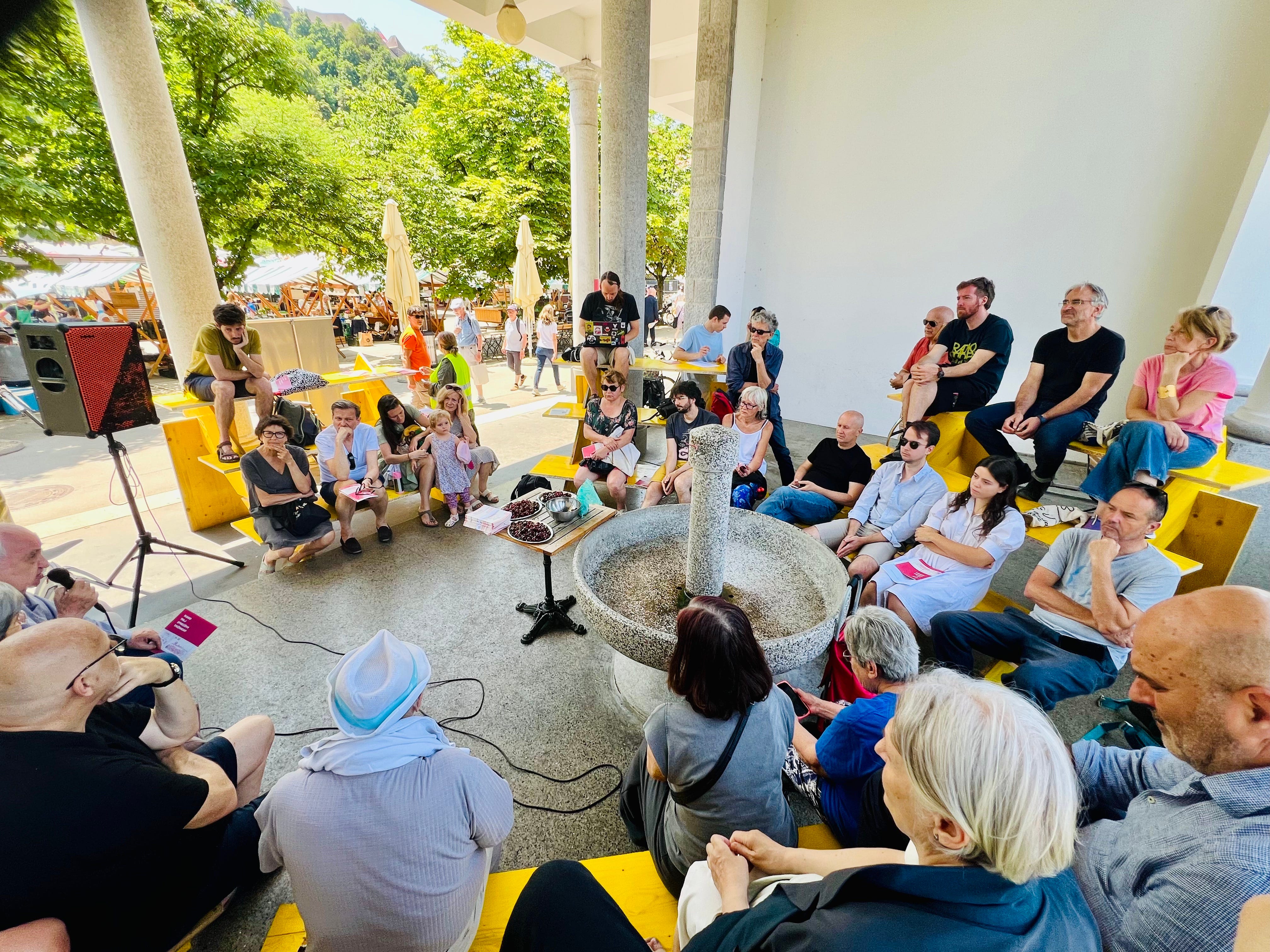
This May, our AGORA initiative went out to meet an audience. My colleague Anze Zadel and I sat on a panel and gave a presentation at the FLUX 2026 Symposium at Loughborough University London, and I led a roundtable called Navigating Media at The Merode in Brussels.
In both instances I was struck by how differently people see media. Beyond their political position or sense of who’s telling the truth, which is certainly a big deal, people see media through the lens of what they need from it. Someone in a social justice position wants more justice. Someone establishing their brand wants to know how to grow an audience. One looks at the algorithm as an obstacle, the other sees a puzzle to crack. Same system, completely different objective (simplifying but hopefully you see the point).
This is Media as a Service (MaaS). Media has largely shifted from a shared public thing into something that functions like a personalized service, and the interplay between the technology and the individual is what makes that work. The algorithm meets your disposition and they shape each other. It’s not just that you get a filtered version of reality. It’s that your needs and the system’s logic co-produce what media is for you. So two people in the same room are essentially in a different world when they say the word “media.”
The idea brought me back to something I wrote in the Culture Systems article, the last piece in the systems series. Culture has always performed a translation function, and in a room where each person sits inside their own co-produced media reality, that function becomes something different. A channel is no longer broadcasting into a shared public space but distributing to multiple media ecosystems that will respond, collect and iterate on the content. The translation layer gets more intimate and malleable. And that changes everything about what media practitioners need to keep society informed.
The AGORA initiative originally emerged from the experience of starting PreLom, an independent community news platform. At the time, there was very little space within mainstream media to report on local community issues from the perspective of the community itself. This space has been steadily shrinking across Europe as large corporations, often also owners of digital platforms, increasingly control major media outlets. At the same time, many people were becoming apathetic toward news and losing trust in traditional media. In response, we started a community news platform that addressed local needs directly and engaged with people not only online, but also through activities and interactions in physical community spaces.
As the initiative developed, we started by asking questions like, what’s going on between media and people, where’s it going wrong and what’s possible? We’ve now identified three structural barriers in the media landscape today:
The first: independent voices are structurally crowded out by algorithms that optimize for engagement rather than accuracy, and by platform ownership concentrated enough to shape what counts as the story.
The second: journalists working on complex topics (technical, economic, civic, etc.) are doing so in conditions where the time and resources serious reporting requires are in short supply and what’s being squeezed out of the profession.
The third: the expert and civic knowledge that exists on subjects is normally incredibly localized, or siloed. Experiments, discoveries and successes by researchers and communities almost never travel far. Progress and knowledge sharing are often marooned.
AGORA responds to each barrier with a corresponding pillar:
The first is the independence anchor. We work with PreLom, and develop stories on direct-to-audience platforms like Substack and Ghost. As the project continues, we plan to engage more publications and develop a network of channels that no centralized owner can switch off. A concrete operational structure that makes independence possible in practice, and the first of what we intend to be a growing set of such relationships with independent publications across Europe.
The second is structural autonomy. Through workshops and a three-year studio course, AGORA studies the research and investigative traditions that have always made serious reporting possible and asks what those forms look like when they move onto platforms journalists control. We develop the models, methods and resources for reporting on complex technical, societal and logistical realities with authority, and train students inside that question. The work they produce lives on these platforms too.
The third is active translation, and it’s where the work creates continuity and legacy. In labs in London and Ljubljana, students engage with subject matter experts to turn civic knowledge into journalism that can travel. Each cohort builds on the last. The work accumulates into investigative reports and multimedia exhibitions, and culminates in a public-facing journalistic academy- a permanent virtual learning space, digital archive and open-access resource.
The deeper logic underneath all this is that AGORA is building toward resilience in media, and in the societies media serves. There is extraordinary work happening across countries everywhere. Researchers, journalists, community platforms and civic innovators are building new forms, new relationships, new ways of getting knowledge to the people who need it. AGORA wants to contribute infrastructure, training and translation capacity to help more of that work survive and thrive in this new media landscape.
If you’re working on related questions, reach out.
AGORA is a co-developed research initiative on independent media, public understanding and democratic resilience, developed in partnership with PreLom, OPOV, Loughborough University London and Zavod Co-Kreate.